How Long Does a Sunset Last?
Mia Chow · · Estimated reading time: 11 minutes
A sunset usually takes about 2 to 4 minutes, from the moment the Sun’s lower edge touches a clear horizon until the last sliver disappears: just over 2 minutes near the equator, and longer the farther you are from it, above all around the solstices. The sunset time we publish on this site marks the end of that interval. The colors start well before it and can go on well after it, so allow more time if you are going out to watch.
How Long Does Today’s Sunset Last Where You Are?
See when today’s sunset starts and ends in your city, and how long it lasts, with tomorrow’s sunrise and sunset. Type any other city, or pick another date, to see its times.
Sunset lasts 2 min 54 s
On Friday, October 23, the Sun touches the horizon in New York at 6:01:01 pm and is gone at 6:03:55 pm, the time we publish as sunset (local time).
 Sunset today6:01:01–6:03:55 pm2 min 54 s
 Sunrise tomorrow7:17:12–7:20:07 am2 min 55 sSunset tomorrow5:59:37–6:02:32 pm2 min 55 s
- Golden hour: the Sun is less than 6° above the horizon, and the light turns warm and soft.
- Dark: the end of civil twilight, when you usually need a light outside. Some color can stay in the sky for a while after.
Calculated for a flat, open horizon at sea level and the standard bending of light by the air, the convention behind published sunrise and sunset times. Hills, buildings, your height or unusual weather can change what you see. Methodology
How long the sunset lasts in New York through 2026, in minutes
The sunset is shortest around the equinoxes (2 min 49 s) and longest around the June solstice (3 min 20 s).
When Does a Sunset Start and End?
A sunset has two moments. It starts when the bottom edge of the Sun touches the horizon, and it ends when the top edge disappears. The sunset time we publish is the second one: the U.S. Naval Observatory defines sunset as the moment the upper edge of the Sun goes below the horizon. So if you want to see the Sun touch the horizon, be there a few minutes before the published time.
Between those two moments the whole Sun has to drop below the horizon, from its bottom edge to its top edge. Seen from Earth the Sun is about half a degree across, half the width of your little finger held at arm’s length, and Earth’s rotation carries it across the sky at about 15° an hour, roughly a quarter of a degree a minute. So if it went straight down, it would be gone in about 2 minutes. It only goes straight down near the equator; elsewhere it goes down at a slant and takes longer, as London shows here:
The same sunset at the equator and in London, 30 times faster
How Long Do the Sunset Colors Last?
The Sun itself is gone in minutes, but the show lasts much longer. It starts with the golden hour, when the Sun is low in the sky (in our times, less than 6° above the horizon) and the light turns warm and soft, with long shadows. After sunset comes the afterglow: the Sun is below the horizon but still lights the sky and the clouds from beneath, and the colors fade through orange, pink and purple to deep blue. By the end of civil twilight, the time we call Dark, you usually need a light outside, but some color can stay low in the western sky for a while after it.
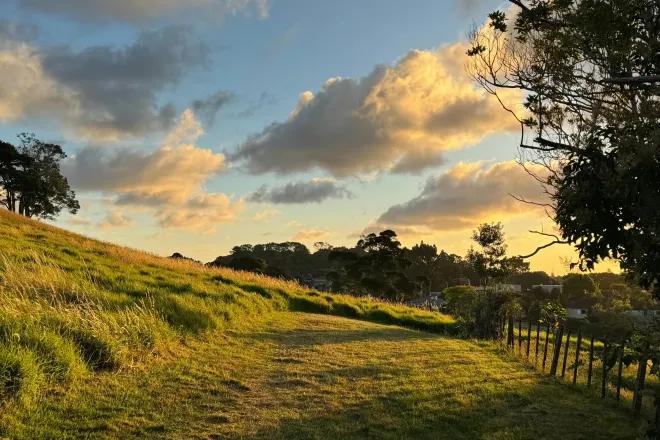
the last 30 to 60 minutes before sunset
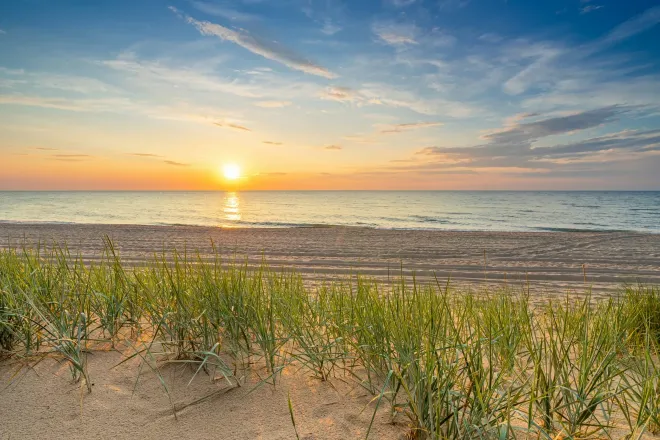
2 to 4 minutes, as the Sun goes down
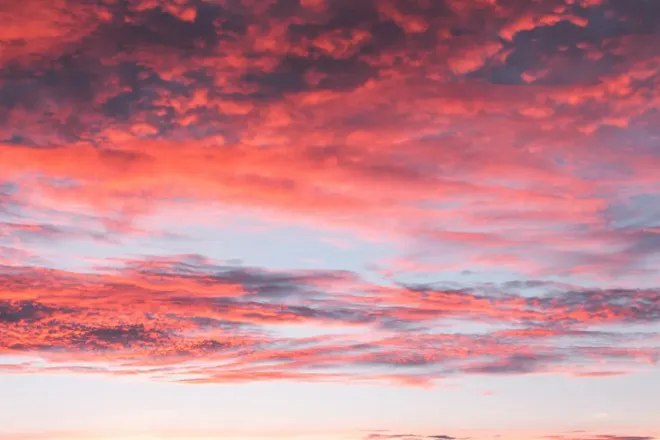
colored sky and clouds after sunset
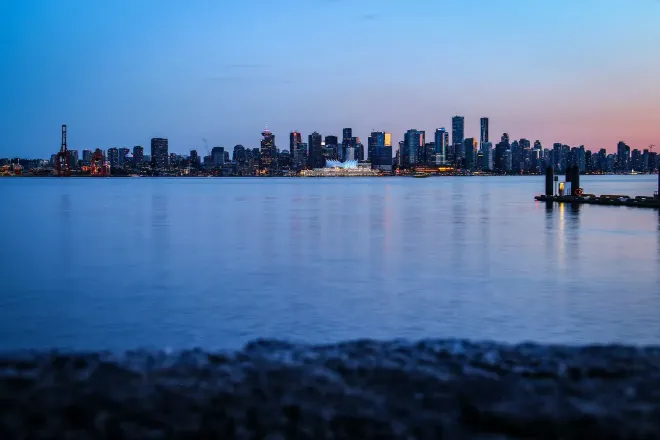
a deep blue sky as it gets dark
A typical evening. The stages overlap, and clouds, haze and dust decide which colors appear and how long they last.
Photos: SR LEE, Wojciech Wyszkowski, Diego PH, Florian Wehde, Unsplash.- Before sunset: the light turns golden about 30 minutes before sunset near the equator, 35 to 45 minutes before in New York and 45 minutes to an hour before in London.
- After sunset: it gets dark about 20 minutes after sunset near the equator, about half an hour after in New York and 35 to 50 minutes after in London.
Some of the best colors come after the Sun is gone, when high clouds catch the last red light. So if you go out to watch a sunset, arrive half an hour before the time on the page and stay until it gets dark.
Why Sunsets Last Longer Far From the Equator
Earth’s rotation carries the Sun across the sky at an almost steady pace. How quickly it drops below the horizon depends on the angle at which its path meets the horizon, and that angle changes with your latitude and the time of year.
Near the equator the Sun goes down almost straight, so the whole disc is below the horizon in about 2 minutes. Farther north or south it goes down at a slant, sliding sideways along the horizon as it sinks, and it has to travel farther before it is gone: that is the difference between the equator and London in the animation above.
The same Sun, three angles: sunset at the March equinox
At the equinoxes that angle is 90° minus your latitude, north or south: about 50° in New York, 38° in London and 56° in Sydney. Around the solstices the path is more slanted still, and the Sun also moves a little more slowly across the sky, so sunsets get longer in both June and December. We explain the angle of the Sun’s path with drawings in Sunrise and Sunset at the Equator. The same angle decides how long it takes to get dark after sunset.
How Long a Sunset Lasts Around the World
The table shows how long the Sun takes to set in ten cities, from Iceland to Australia, on the four key dates of this year.
How long the Sun takes to set, 2026
| City | March 20–21 equinox | June 21 solstice | September 22–23 equinox | December 21–22 solstice |
|---|---|---|---|---|
| Reykjavík 64° N | 4 min 54 s | 13 min 32 s | 4 min 52 s | 10 min 48 s |
| Anchorage 61° N | 4 min 26 s | 8 min 16 s | 4 min 26 s | 7 min 31 s |
| London 52° N | 3 min 26 s | 4 min 31 s | 3 min 25 s | 4 min 23 s |
| Seattle 48° N | 3 min 10 s | 3 min 57 s | 3 min 10 s | 3 min 53 s |
| New York 41° N | 2 min 49 s | 3 min 20 s | 2 min 48 s | 3 min 17 s |
| Los Angeles 34° N | 2 min 35 s | 2 min 57 s | 2 min 35 s | 2 min 55 s |
| Miami 26° N | 2 min 22 s | 2 min 39 s | 2 min 22 s | 2 min 38 s |
| Mumbai 19° N | 2 min 15 s | 2 min 29 s | 2 min 16 s | 2 min 29 s |
| Singapore 1° N | 2 min 8 s | 2 min 19 s | 2 min 8 s | 2 min 20 s |
| Sydney 34° S | 2 min 34 s | 2 min 55 s | 2 min 34 s | 2 min 57 s |
- The equator is the fastest, and the steadiest. In Singapore the Sun sets in a little over 2 minutes all year round; in Reykjavík a sunset goes from about 5 minutes in March and September to more than 13 in June.
- Both solstices bring long sunsets, not just the summer one. In New York and London the sunsets around Christmas last about as long as those of late June. Only far north do the June ones pull ahead.
- The Southern Hemisphere works the same way. Sydney is about as far south as Los Angeles is north, and its sunsets last about the same 2½ to 3 minutes.
Minutes the Sun takes to set, 2026
The Longest Sunsets on Earth
The longest sunsets happen near the Arctic and Antarctic Circles. There the Sun’s path meets the horizon at a very shallow angle, and when it almost runs along the horizon, a sunset can last half an hour or more. Places close to the polar circles get this twice a year: in spring and summer, on the last evenings before the midnight sun and the first ones after it, and in late autumn and winter, on the last days before the polar night and the first ones after it, when the Sun only just clears the horizon at noon and slides along it as it sets.
The longest sunset of 2026 in the far north
| City | Longest sunset | Date | Midnight sun | Polar night |
|---|---|---|---|---|
| Reykjavík 64° N | 13 min 32 s | June 19 | none | none |
| Fairbanks 65° N | 17 min 19 s | June 20 | none | none |
| Akureyri 66° N | 38 min 14 s | June 20 | none | none |
| Rovaniemi 67° N | 39 min 1 s | June 5 | 30 days | none |
| Bodø 67° N | 47 min 47 s | December 11 | 42 days | none |
| Murmansk 69° N | 39 min 33 s | January 14 | 62 days | 40 days |
| Tromsø 70° N | 44 min 40 s | May 17 | 68 days | 48 days |
| Hammerfest 71° N | 47 min 11 s | January 22 | 78 days | 59 days |
| Utqiaġvik 71° N | 37 min 32 s | November 16 | 83 days | 64 days |
The winter ones are the strangest. In Bodø, in northern Norway, the longest sunsets of the year come in December and early January, at about lunchtime: the Sun is up for less than two hours around noon, and setting takes it more than half an hour. Right at the winter solstice its whole disc never even clears the horizon.
Tromsø, farther north, has both seasons, with the midnight sun in summer and the polar night in winter. This is how long its sunsets last through the year:
How long the sunset lasts in Tromsø through 2026, in minutes
The sunset is shortest around the equinoxes (6 min 7 s) and longest around May 17 (44 min 40 s), next to the gaps in the line. The gaps are days with no full sunset to time: the polar night and the midnight sun.
In May the evenings stretch out until the last sunset before the midnight sun takes more than half an hour. On the first few nights of the midnight sun the Sun still dips partly below the horizon around midnight, then comes back up without setting:
The Sun dips but does not set: Tromsø’s first night of the midnight sun
At the poles a single sunset lasts more than a day. At the North Pole the Sun sets only once a year, around the September equinox: it circles the sky just above the horizon, a little lower each turn. At the South Pole the same happens around the March equinox. In 2026 the Sun touched the horizon at the North Pole on September 23, 6:39 pm UTC and was gone on September 25, 3:31 am UTC, 32 h 52 min later. At the South Pole it set between March 21, 8:51 am UTC and March 22, 5:16 pm UTC.
The slowest sunset: the North Pole in September
Those times are less certain than any other on this page. With the Sun this low and moving this slowly, a little more or less bending of its light by cold air moves the moment it disappears by hours.
Find Today’s Sunset for Your City
Every place page shows today’s sunrise and sunset to the second, with first light, dark and night. Type your city to find yours:
Frequently Asked Questions
How long does a sunrise last?
Away from the polar regions, about as long as that day’s sunset, give or take a few seconds: just over 2 minutes near the equator and 3 to 4 minutes in most of the United States and Europe. Near the polar circles, where the days get longer or shorter fast, a sunrise and the sunset of the same day can differ by several minutes. The sunrise time we publish is the moment the top edge of the Sun appears, so the whole disc is up a few minutes later.
How fast does the Sun set?
The Sun moves roughly a quarter of a degree a minute across the sky. It is about half a degree across, so it takes about two minutes to move by its own size. On any given day that pace is about the same everywhere on Earth; what makes one sunset longer than another is mostly the angle of the Sun’s path to the horizon.
Is the Sun really there when I see it touch the horizon?
No. Near the horizon the air bends the Sun’s light upward by a little more than half a degree, more than the Sun measures from top to bottom. So when you see it sitting on the horizon, it is in fact already just below it, and you keep seeing it for a few minutes longer than you would without air. The times we publish include the standard amount of this bending; on unusually cold or warm evenings the real bending is different, and what you see can be a minute or so off.
Why does the Sun look flattened at sunset?
Because the air bends the light more the closer it is to the horizon, the bottom of the Sun is lifted more than the top, and the disc looks squashed, wider than it is tall. The Sun also looks bigger near the horizon, but that is an illusion: measured, it is no bigger.
Do mountains or the sea change how long a sunset lasts?
They can. Our times assume a flat, open horizon at sea level, like the sea. A hill or a mountain range to the west hides the Sun earlier, and how long it takes to disappear behind it depends on the slope of the land as well as on the Sun. From high up, on a mountain or in a plane, the horizon is lower and the Sun sets a little later.
 Eswatini
 Lesotho
 Puerto Rico