Green Flash at Sunset: What It Is and When to See It
Mia Chow · · Estimated reading time: 9 minutes
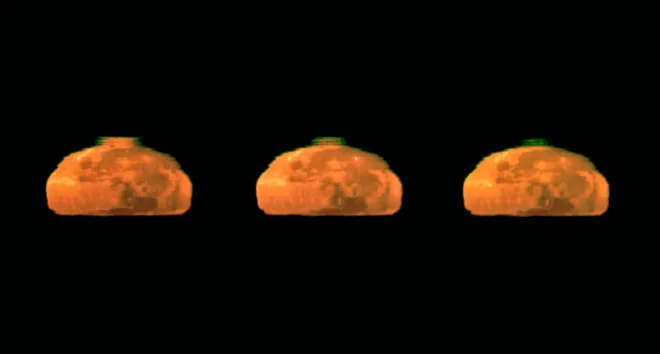
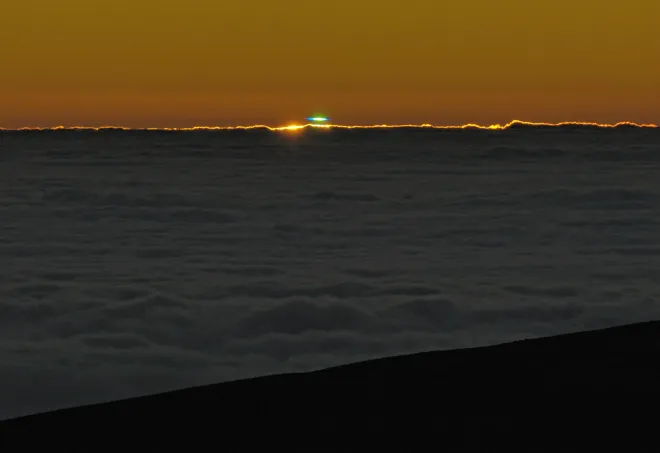
The green flash is a brief burst of green light at the very top of the Sun, seen in the last second or two of a sunset, as the final sliver drops below the horizon. It also happens at sunrise, as the first sliver appears. It is real, it is caused by the air bending sunlight like a weak prism, and with a clear, distant horizon, the sea above all, you have a fair chance of catching it. It is not visible at every sunset: you need a clear, distant horizon and the right air. The trick is knowing when to look, and where.
Watch at 4:30:34 pm
On Friday, November 27, the last edge of the Sun disappears in New York at 4:30:34 pm (local time), in the west-southwest (242°). That is the moment to watch for the green flash; be in place a couple of minutes before, since real air can shift it. Estimated for clear air, the flash would last about 1.4 seconds; a mirage near the horizon can stretch it.
 First edge appears tomorrow6:56:32 amin the east-southeast (118°)
 Last edge gone tomorrow4:30:34 pmin the west-southwest (242°)
You will only see it if:
- the horizon where the Sun sets, to the west-southwest, is distant and sharp: the sea is best, a flat deck of clouds or far mountains can work;
- the air is clear right down to it, with no haze or clouds low on the horizon;
- the layers of air near the horizon magnify the green edge, which happens on some evenings and not others.
Calculated for a flat, open horizon at sea level and the standard bending of light by the air, the convention behind published sunrise and sunset times. Hills, buildings, your height or unusual weather can change what you see. Methodology
What is the green flash?
Near the horizon, sunlight crosses a long, thick stretch of air, and the air bends it upward. That is why you still see the Sun for a few minutes after it has geometrically set. The air bends each color by a slightly different amount: red the least, then yellow, then green, then blue. So the Sun you see is really a stack of colored suns, each lifted a little higher than the one before, with the green one a hair above the red.
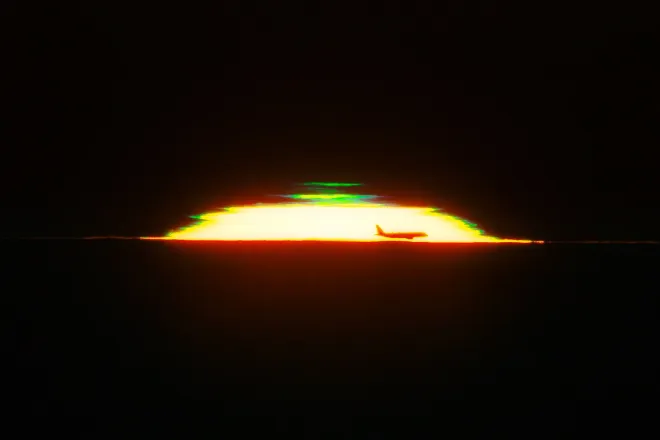
Most of the time the colors overlap and the Sun looks yellow or orange. But in the last moment of a sunset, when only a thin sliver is left, the red image drops below the horizon first, then the yellow. For an instant, only the green edge remains, as in the drawing above. That instant is the green flash. Very often a layer of warmer or cooler air near the horizon acts as a mirage and magnifies that green edge into a band you can actually see; most flashes owe their size to one. Blue is bent even more, but on its long, low path through the air most blue light is scattered away, which is also why the sky above is blue. When the air is exceptionally clear, a blue flash can follow the green one.
When to look
The green flash comes as the top edge of the Sun disappears. That is the moment published as sunset: the time on our pages is when the upper edge of the Sun drops below a flat horizon, not when the Sun touches it. So the box above gives you the second to aim for, and the direction to face. Real air bends light a little more or less than the standard, and your height above the sea lowers the horizon, so the true moment can come a minute or more early or late, and much more at high latitudes or from high up; a mirage flash can also appear a few seconds before the last edge goes. Be in place a couple of minutes ahead.
The usual flash shows only when the Sun is down to a thin line. Before that, the glare overwhelms your eyes and you would miss it anyway. At sunrise, the flash comes as the first point of the Sun appears, and the hard part is knowing exactly where on the horizon to look: the direction in the box helps.
How long does it last?
The green edge is very thin: in standard air near the horizon, the green image sits only about a quarter of an arcminute above the red one, less than a hundredth of the Sun’s width. In a simple model, the flash lasts as long as the Sun takes to sink by that tiny amount. That depends on how fast the Sun sets, which depends on where you are and the time of year. Near the equator, where the Sun drops almost straight down, that gives about a second. In this simple model, a more slanted path makes the edge cross the horizon more slowly and the flash longer. Latitude and season both set that angle: the path is steepest near the equator and flattest near the poles.
Estimated length of the green flash in clear air, 2026
| City | March 20–21 equinox | June 21 solstice | September 22–23 equinox | December 21–22 solstice |
|---|---|---|---|---|
| Reykjavík 64° N | 2.2 s | 6.0 s | 2.2 s | 4.8 s |
| Anchorage 61° N | 2.0 s | 3.7 s | 2.0 s | 3.4 s |
| London 52° N | 1.5 s | 2.0 s | 1.5 s | 2.0 s |
| Seattle 48° N | 1.4 s | 1.8 s | 1.4 s | 1.7 s |
| New York 41° N | 1.3 s | 1.5 s | 1.3 s | 1.5 s |
| Los Angeles 34° N | 1.2 s | 1.3 s | 1.2 s | 1.3 s |
| Miami 26° N | 1.1 s | 1.2 s | 1.1 s | 1.2 s |
| Mumbai 19° N | 1.0 s | 1.1 s | 1.0 s | 1.1 s |
| Singapore 1° N | 1.0 s | 1.0 s | 1.0 s | 1.0 s |
| Sydney 34° S | 1.1 s | 1.3 s | 1.1 s | 1.3 s |
Those are model times in plain air. What you see can differ: a mirage near the horizon often stretches the top of the Sun into a thin band and makes the flash longer and easier to see, and haze can make it too faint to notice. Most observers describe it as lasting a second or two.
The longest flashes happen where the Sun barely rises or sets and its edge skims along the horizon for a long time. In the polar regions, near the start and end of the polar night, the green rim can come and go for many minutes. On October 16, 1929, five members of Richard Byrd’s Antarctic expedition at Little America saw green flashes come and go for about 35 minutes as the Sun skimmed the horizon. A later study found that strong, changing refraction and their climb up the camp’s radio masts explain why its edge kept coming back into view.
Where you can see it
Three things give you the best chance: a distant, flat, sharp horizon, clear air right down to it, and a Sun still bright when it sets. A cloud bank or haze on the horizon usually hides the flash even on a sunny evening, and a Sun that turns dim and deep red as it goes down rarely gives one.
- The sea. An ocean horizon to the west is the classic place: the coasts of California, Florida’s Gulf Coast, Hawaii, the Atlantic coasts of Europe and Africa. For sunrise, a horizon to the east.
- Deserts and plains. Any long, flat, unobstructed horizon works, if the air is clear.
- High places. A mountain or an airplane gives a distant, low horizon and often very clear air. Some of the rare blue and violet flashes have been seen from mountain observatories.
How to watch it safely
Never look straight at the Sun while it is still a disc: it can hurt your eyes. Never use binoculars, a telescope or a camera’s optical viewfinder while any part of the Sun is up. The safest way to watch is on a screen: film the last minute with a phone or a camera set to video or a fast burst, zoomed in if you can, and watch the screen, not the Sun.
A tip from experienced watchers: once the flash is over, do not look back at the spot right away. The bright afterimage of the Sun in your eyes can look greenish too, and it is not the real thing.
Why it is famous
The green flash owes much of its fame to Jules Verne. In his 1882 novel The Green Ray, a young Scottish woman refuses to marry until she has seen it, because, as the novel tells it, an old legend says that whoever sees the green ray can no longer be deceived in matters of the heart. In 1986, Éric Rohmer’s film of the same name ended with its heroine watching the sunset for it. Sailors and island hotels have chased it ever since, and in many seaside towns people still gather to watch the Sun go down and cheer when the green appears.
Frequently Asked Questions
Is the green flash real?
Yes. It has been photographed and measured many times, and its cause is well understood: the air bends green light slightly more than red, so the green image of the Sun’s edge is the last to set, often magnified by a mirage. It is not an effect of tired eyes, although the afterimage of the Sun can add to the confusion.
Can you see the green flash at sunrise?
Yes, as the first sliver of the Sun appears. It is reported less often, partly because fewer people are watching and partly because it is hard to know exactly where on the horizon the Sun will come up. Face the direction given in the box above and be ready a minute or two before the time shown.
Can you see the green flash at every sunset?
No, only when the conditions are right. The colors separate at every sunset, and a thin green rim sits on top of the Sun every time, but it is too thin to see without a telephoto lens. You see a flash only when the horizon is sharp, the air near it clear and the layers of air near the horizon right to magnify it, over the sea, flat land or a deck of clouds. On a cloudless evening by the sea, your odds are fair; many people need a few tries. Haze, clouds on the horizon or hills in the way usually hide it.
Why is it green and not blue?
Blue light is bent even more than green, so a blue image should sit on top. But blue light is scattered away by the air on its long, low path to your eyes, so usually little of it is left. When the air is exceptionally clean and dry, as on some high mountains, a blue or even violet flash can sometimes be seen.
What is the green ray at sunset?
A green ray is a much rarer sight than the flash: a thin beam of green light that seems to shoot up from the horizon for a moment, right as or just after the Sun disappears. It needs exceptionally clear air, and few people ever see one. The name is also often used for the green flash itself, especially in French and Spanish, where le rayon vert and el rayo verde are the usual names.
Can you see the green flash with the Moon or planets?
Sometimes. Similar flashes have been seen and photographed on the setting Moon and on bright planets such as Venus, though they are much fainter than the Sun’s.