Total Solar Eclipse of August 2, 2027: Where, When and How Long
Mia Chow · · Estimated reading time: 14 minutes
On Monday, August 2, 2027, the Moon's shadow will cross from the Atlantic to the Indian Ocean and turn day into dusk over southern Spain, North Africa and Arabia. The Sun will vanish for 2 min 54 s in Cádiz, 4 min 50 s in Tangier and 6 min 21 s in Luxor. The Moon will cover 42% of the Sun in London, 86% in Madrid and 95% in Cairo. The United States gets almost nothing.
- 42%London
- 75%Rome
- 86%Madrid
- 95%Cairo
- 100%Luxor
What time, and how much, in your city
The eclipse can be seen across Europe, northern and eastern Africa, the Middle East and South Asia, and the clock is different everywhere. In London it begins at 9:03 am and peaks at 10:00 am. In Cairo it peaks just before 1:00 pm, in Mumbai at 4:41 pm. Type your city to see its local times and how much of the Sun will be covered, then press play and watch the eclipse run minute by minute.
100%
In Cádiz the Sun will be completely covered for 2 min 54 s, from 10:45 am.
Never look at the Sun without eclipse glasses. How to watch it safely
In the Americas, it barely registers. Atlantic Canada sees it at sunrise: St. John's reaches 29% about half an hour later, and Halifax catches the end, with 15% covered as the Sun comes up. Parts of northern and eastern Maine get a sliver at sunrise, up to about 3%, and the rest of the United States, Latin America and the Caribbean see nothing. The same goes for Australia, Japan and South Africa.
Where the Sun disappears completely
The path of totality is about 250 km (155 miles) wide. It comes in from the Atlantic and crosses southern Spain, Gibraltar, northern Morocco, Algeria, Tunisia, Libya and Egypt, then clips a corner of Sudan before running across Saudi Arabia, Yemen and northern Somalia. From Cádiz to Somalia the shadow takes a little over two hours. As far as Egypt, the farther east it goes, the longer the darkness lasts and the higher the Sun stands.
The path of totality and August's clouds
Where the Sun disappears completely
| Place | Totality begins (local time) | Lasts | Sun height | Clouds in August |
|---|---|---|---|---|
| Cádiz Spain | 10:45 am | 2 min 54 s | 37° | 24% |
| Málaga Spain | 10:48 am | 1 min 52 s | 39° | 22% |
| Tarifa Spain | 10:45 am | 4 min 38 s | 38° | 22% |
| Gibraltar | 10:45 am | 4 min 27 s | 38° | 22% |
| Ceuta Spain | 10:45 am | 4 min 49 s | 38° | 24% |
| Tangier Morocco | 8:44 am | 4 min 50 s | 38° | 24% |
| Oran Algeria | 9:51 am | 5 min 08 s | 43° | 30% |
| Mahdia Tunisia | 10:10 am | 2 min 45 s | 56° | 24% |
| Sfax Tunisia | 10:08 am | 5 min 39 s | 56° | 21% |
| Djerba Tunisia | 10:09 am | 4 min 25 s | 56° | 19% |
| Benghazi Libya | 11:27 am | 6 min 09 s | 67° | 15% |
| Sohag Egypt | 12:58 pm | 6 min 22 s | 81° | 7% |
| Luxor Egypt | 1:02 pm | 6 min 21 s | 82° | 8% |
| Jeddah Saudi Arabia | 1:22 pm | 5 min 58 s | 77° | 41% |
| Abha Saudi Arabia | 1:34 pm | 6 min 03 s | 72° | 58% |
| Sanaa Yemen | 1:44 pm | 2 min 25 s | 67° | 64% |
| Bosaso Somalia | 1:58 pm | 4 min 04 s | 58° | 36% |
Inside the path, what counts is how close you are to its center line. Tarifa and Ceuta, close to the middle, get more than four and a half minutes. Málaga, near the northern edge, gets less than two.
A 99% eclipse is not a total eclipse
Seville will reach 98.4% and Granada 99.2%. Faro, in Portugal's Algarve, 99.2%. Tripoli stops at 99.9%, Algiers and Aswan at 99.8%. Casablanca and Tunis get 97%, Cairo 95%. These numbers sound almost like 100%, but a partial eclipse is a different event.
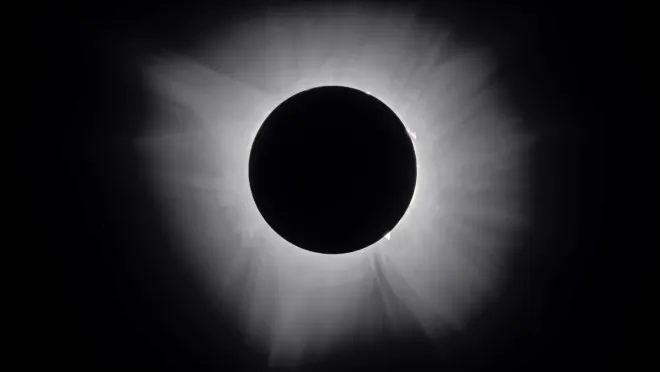
The last 1% of the Sun still shines about 4,000 times brighter than a full Moon. It stays daytime, you still need your glasses, and you never see the corona, the Sun's pale outer atmosphere, which is the thing people cross the world for. Only when the last point of light goes out does twilight fall in seconds and the stars come out.
So if you are close to the path, go. From Almería to Roquetas de Mar, about 20 km, you go from nothing to 1 min 34 s. From Granada to Motril, about 70 km, to 1 min 41 s. From Seville to Jerez, about 90 km, to about a minute and a half. Just do not stop at the line itself: where totality lasts a few seconds, a small error in the place you pick can cost you all of it. Go far enough in to get at least a minute.
How much of the Sun, everywhere else
Outside the path, coverage falls away gradually with distance. Britain and Ireland get a morning eclipse: 27% in Edinburgh, 36% in Dublin, 42% in London, 47% in Cornwall. Paris gets 51%. Rome and Athens are around three quarters. In Spain, Barcelona reaches 82%. South Asia gets it in the late afternoon, with 32% in Mumbai and 30% in Karachi, and by Delhi and Moscow it has faded to a nibble of 8% or 9%.
How much of the Sun the Moon will cover
The eclipse around the world, in local time
| City | Begins | Deepest | Ends | Covered |
|---|---|---|---|---|
| Luxor | 11:40 am | 1:05 pm | 2:26 pm | 100% |
| Benghazi | 10:10 am | 11:30 am | 12:53 pm | 100% |
| Jeddah | 12:00 pm | 1:25 pm | 2:43 pm | 100% |
| Sfax | 8:56 am | 10:11 am | 11:31 am | 100% |
| Oran | 8:44 am | 9:53 am | 11:09 am | 100% |
| Mecca | 12:02 pm | 1:26 pm | 2:44 pm | 100% |
| Tangier | 7:40 am | 8:47 am | 10:00 am | 100% |
| Gibraltar | 9:41 am | 10:47 am | 12:01 pm | 100% |
| Cádiz | 9:40 am | 10:46 am | 11:59 am | 100% |
| Sanaa | 12:21 pm | 1:45 pm | 3:00 pm | 100% |
| Málaga | 9:42 am | 10:49 am | 12:02 pm | 100% |
| Tripoli | 9:59 am | 11:16 am | 12:38 pm | 99.9% |
| Algiers | 8:48 am | 9:59 am | 11:15 am | 99.8% |
| Aswan | 11:42 am | 1:08 pm | 2:29 pm | 99.8% |
| Faro | 8:40 am | 9:45 am | 10:57 am | 99.2% |
| Granada | 9:42 am | 10:50 am | 12:03 pm | 99.2% |
| Rabat | 7:39 am | 8:45 am | 9:58 am | 99% |
| Hurghada | 11:41 am | 1:05 pm | 2:25 pm | 99% |
| Fès | 7:40 am | 8:47 am | 10:01 am | 98% |
| Seville | 9:41 am | 10:47 am | 12:00 pm | 98% |
| Casablanca | 7:38 am | 8:44 am | 9:57 am | 97% |
| Tunis | 8:56 am | 10:10 am | 11:28 am | 97% |
| Aden | 12:28 pm | 1:51 pm | 3:05 pm | 96% |
| Sharm el-Sheikh | 11:41 am | 1:05 pm | 2:24 pm | 96% |
| Cairo | 11:33 am | 12:55 pm | 2:16 pm | 95% |
| Medina | 11:57 am | 1:20 pm | 2:38 pm | 94% |
| Alexandria | 11:29 am | 12:51 pm | 2:12 pm | 93% |
| Lisbon | 8:40 am | 9:44 am | 10:55 am | 93% |
| Palermo | 10:00 am | 11:15 am | 12:33 pm | 90% |
| Palma | 9:49 am | 10:58 am | 12:13 pm | 89% |
| Marrakesh | 7:37 am | 8:43 am | 9:56 am | 89% |
| Madrid | 9:45 am | 10:51 am | 12:02 pm | 86% |
| Porto | 8:43 am | 9:46 am | 10:55 am | 83% |
| Barcelona | 9:50 am | 10:58 am | 12:11 pm | 82% |
| Tel Aviv | 11:39 am | 12:59 pm | 2:16 pm | 80% |
| Amman | 11:42 am | 1:02 pm | 2:18 pm | 78% |
| Athens | 11:16 am | 12:32 pm | 1:50 pm | 78% |
| Riyadh | 12:13 pm | 1:32 pm | 2:44 pm | 76% |
| Rome | 10:02 am | 11:12 am | 12:26 pm | 75% |
| Male | 3:29 pm | 4:32 pm | 5:29 pm | 73% |
| Marseille | 9:55 am | 11:03 am | 12:14 pm | 73% |
| Toulouse | 9:52 am | 10:58 am | 12:08 pm | 73% |
| Khartoum | 10:57 am | 12:22 pm | 1:42 pm | 71% |
| Addis Ababa | 12:24 pm | 1:47 pm | 3:01 pm | 67% |
| Mogadishu | 12:53 pm | 2:10 pm | 3:18 pm | 63% |
| Doha | 12:24 pm | 1:38 pm | 2:46 pm | 62% |
| Istanbul | 11:27 am | 12:39 pm | 1:50 pm | 59% |
| Zürich | 10:03 am | 11:07 am | 12:14 pm | 55% |
| Dubai | 1:33 pm | 2:44 pm | 3:48 pm | 53% |
| Colombo | 4:05 pm | 5:01 pm | 5:53 pm | 52% |
| Paris | 10:00 am | 11:01 am | 12:05 pm | 51% |
| Munich | 10:08 am | 11:11 am | 12:17 pm | 50% |
| Brussels | 10:05 am | 11:04 am | 12:05 pm | 43% |
| Cardiff | 9:01 am | 9:57 am | 10:56 am | 42% |
| London | 9:03 am | 10:00 am | 10:59 am | 42% |
| Bengaluru | 3:58 pm | 4:53 pm | 5:43 pm | 39% |
| Amsterdam | 10:09 am | 11:05 am | 12:03 pm | 38% |
| Dublin | 9:03 am | 9:56 am | 10:51 am | 36% |
| Manchester | 9:06 am | 9:59 am | 10:55 am | 35% |
| Berlin | 10:17 am | 11:13 am | 12:11 pm | 34% |
| Mumbai | 3:47 pm | 4:41 pm | 5:31 pm | 32% |
| Belfast | 9:06 am | 9:57 am | 10:50 am | 32% |
| Nairobi | 12:52 pm | 2:01 pm | 3:04 pm | 31% |
| Karachi | 3:01 pm | 3:57 pm | 4:48 pm | 30% |
| St. John's | 5:39 am | 6:09 am | 6:51 am | 29% |
| Glasgow | 9:10 am | 9:59 am | 10:50 am | 28% |
| Edinburgh | 9:11 am | 10:00 am | 10:51 am | 27% |
| Dakar | 7:41 am | 8:30 am | 9:24 am | 26% |
| Dar es Salaam | 1:12 pm | 2:13 pm | 3:09 pm | 22% |
| Halifax | 6:01 am | – | 6:20 am | 15% |
| Oslo | 10:31 am | 11:13 am | 11:55 am | 14% |
| Stockholm | 10:37 am | 11:19 am | 12:01 pm | 13% |
| Moscow | 12:00 pm | 12:39 pm | 1:18 pm | 9% |
| Delhi | 3:53 pm | 4:29 pm | 5:02 pm | 8% |
| Lahore | 3:17 pm | 3:52 pm | 4:25 pm | 7% |
| Kolkata | 4:14 pm | 4:44 pm | 5:12 pm | 6% |
| Reykjavík | 8:30 am | 8:59 am | 9:28 am | 6% |
| Dhaka | 4:49 pm | 5:13 pm | 5:35 pm | 3% |
| Lagos | 9:42 am | 10:13 am | 10:46 am | 2% |
| Accra | 8:44 am | 9:04 am | 9:25 am | 1% |
What you will actually see
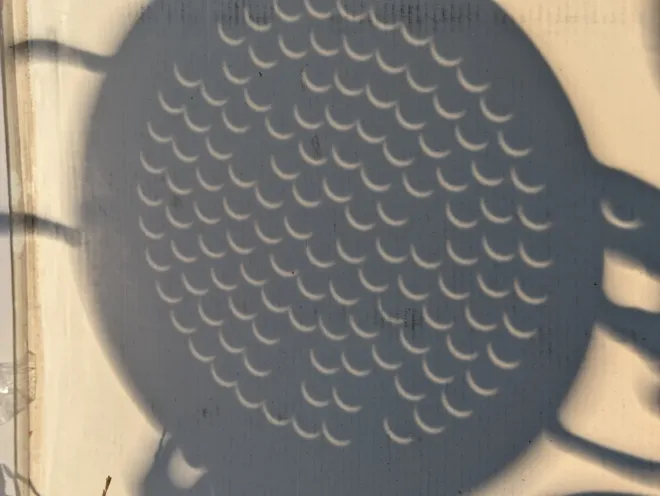
Below about 80%, you may not notice if nobody tells you. The eye adapts, and what remains of the Sun is plenty for an ordinary August day. The surprise is on the ground: under a tree, the gaps between the leaves project hundreds of tiny crescent Suns.
Around 85%, as in Madrid, the light starts to drop for no obvious reason. Shadows sharpen and colors lose some of their strength.
Above 90%, it is impossible to miss. The light turns cold and metallic, strange for a summer day, and the air cools.
From 96% up, the sky deepens to an intense blue and the Sun shrinks to a very thin sickle. It is almost the whole show, without the ending.
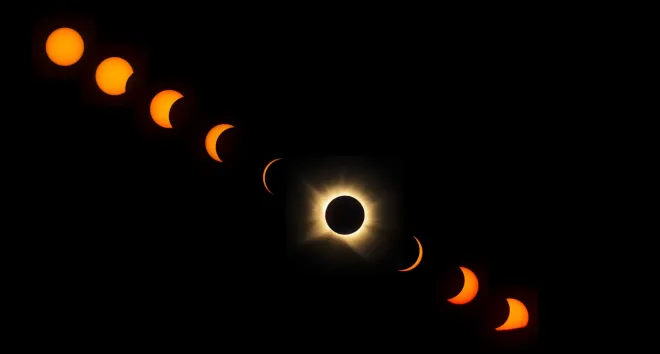
Inside the path, the light falls faster and faster in the final minutes. The darkness arrives from the west, and just before totality a few beads of light are left on the Moon's edge, then only one, like a diamond on a ring. Then nothing: a black disc ringed by the corona, the brightest stars and planets in a twilight sky, and a sunset glow along the whole horizon. The temperature falls by a few degrees, though the coldest moment usually comes a little later. Minutes later, the first flash, and it is day again. Do not spend it behind your phone, and put your glasses back on before the Sun returns.
Where to go
The choice comes down to how long totality lasts, what the sky usually does at that hour, and how many people will have had the same idea. Few eclipses of recent decades come with better prospects, but the averages hide a few traps.
Spain is the easiest to reach, with the shortest totality. It comes around 10:45 am, with the Sun about 38° up and toward the east, so check that no building, tree or hill will block it from your spot. The enemy in August is not storms but the low cloud that drifts in from the sea in the morning.
Where it goes dark in southern Spain
The Atlantic coast of Cádiz has long totality, with 4 min 01 s in Conil, 4 min 16 s in Barbate and 4 min 38 s in Tarifa, but it is the most exposed to early sea fog. In observations from July 12 to August 18 in 2024 and 2025, the Sun was visible at eclipse time on 88% of days in Cádiz and 74% between Barbate and Tarifa. A few dozen kilometers inland, average cloud falls below 15%, and totality is still long: 4 min 06 s in Vejer de la Frontera, 3 min 21 s in Medina Sidonia. That is the safest bet in Spain.
The Costa del Sol nearly always escapes the Atlantic cloud, which rarely gets past Tarifa: 3 min 37 s in Estepona, 3 min 16 s in Marbella, 3 min 10 s in Fuengirola, 1 min 52 s in Málaga. If you can choose, every kilometer west of Málaga adds seconds. It is also one of the most crowded coasts in Spain in August.
How long the Sun disappears in Spain and Gibraltar
| Place | Totality begins | Lasts | Sun height |
|---|---|---|---|
| Ceuta | 10:45 am | 4 min 49 s | 38° |
| Tarifa | 10:45 am | 4 min 38 s | 38° |
| Melilla | 10:48 am | 4 min 34 s | 41° |
| Algeciras | 10:45 am | 4 min 27 s | 38° |
| Gibraltar | 10:45 am | 4 min 27 s | 38° |
| Barbate | 10:45 am | 4 min 16 s | 37° |
| Vejer de la Frontera | 10:45 am | 4 min 06 s | 37° |
| Estepona | 10:46 am | 3 min 37 s | 38° |
| Chiclana de la Frontera | 10:45 am | 3 min 29 s | 37° |
| Medina Sidonia | 10:45 am | 3 min 21 s | 38° |
| Marbella | 10:46 am | 3 min 16 s | 39° |
| San Fernando | 10:45 am | 3 min 12 s | 37° |
| Fuengirola | 10:47 am | 3 min 10 s | 39° |
| Cádiz | 10:45 am | 2 min 54 s | 37° |
| El Puerto de Santa María | 10:45 am | 2 min 28 s | 37° |
| Málaga | 10:48 am | 1 min 52 s | 39° |
| Almuñécar | 10:49 am | 1 min 51 s | 40° |
| Adra | 10:49 am | 1 min 45 s | 41° |
| Motril | 10:49 am | 1 min 41 s | 40° |
| Jerez de la Frontera | 10:46 am | 1 min 37 s | 37° |
| Roquetas de Mar | 10:50 am | 1 min 34 s | 41° |
| El Ejido | 10:50 am | 1 min 23 s | 41° |
| Ronda | 10:47 am | 1 min 19 s | 39° |
| Vélez-Málaga | 10:48 am | 1 min 03 s | 40° |
Gibraltar sits close to the center line, with 4 min 27 s. When the easterly levanter blows, the Rock trails its own cloud, so check the wind the day before.
In Morocco the exact spot matters. Tangier gets 4 min 50 s and Tetouan 4 min 51 s. In Tangier, choose the center or east of the city and the beaches on the bay: on the western beaches, and at Asilah or Larache, the cloud can outlast totality. Also check your clocks. Morocco stays on UTC all year now, so totality in Tangier comes at 8:44 am, while in Tarifa, just across the Strait, it comes at 10:45 am.
Tunisia is the sensible compromise. The Sun stands at 56° and mornings are rarely cloudy: 5 min 39 s in Sfax, 4 min 25 s on Djerba, 2 min 45 s in Mahdia. In Tunisia as in Algeria, where Oran gets 5 min 08 s, clouds build mostly in the afternoon, after the eclipse is over. The real enemy is dust on the sirocco, which can be forecast up to three days ahead.
Egypt is the safe bet for clear skies. In Luxor the Sun disappears for 6 min 21 s almost straight overhead, at 82°, a little after 1:00 pm, with the temples of Karnak and the Valley of the Kings inside the path. The average high on this date is 42 °C (108 °F), so plan the day around shade and water. A camera can shut itself down in that heat: keep it shaded, dry and well ventilated. In parts of the path through Libya and western Egypt, 23 years of records show no cloud on August 2. The main threat is thin high cloud, which does not stop you from seeing the eclipse.
Beyond the Red Sea, totality is still long, but clouds and dust increase. Jeddah gets 5 min 58 s, with cloud covering about 40% of the sky on average, and it builds toward the highlands around Abha and in Yemen.
Before you book anything, read your government's travel advice, which matters for several countries on this list. The UK Foreign Office, for example, advises against travel to all or parts of Libya, Sudan, Yemen and Somalia.
And plan early. By August 2026, a villa in El Palmar, on the Cádiz coast, was already advertised at €33,129 a night, lodgings in Tarifa at more than €11,000, and some hotels in Cádiz had closed bookings for those dates. Arrive the day before, do not stop on the shoulder of a road, do not park on dry grass, and bring water and shade: the whole eclipse takes more than two hours, in the middle of an August day. Have a plan B as well. The eclipse itself cools the air, and on a humid coast that can bring the fog back just before totality, so if the morning looks doubtful, move early and stay inside the path.
Why it lasts so long
Three things line up. Earth is only a month past its farthest point from the Sun, reached on July 5, so the Sun looks a little smaller. The Moon reaches its closest point to Earth that very morning, at 357,362 km, so it looks a little larger. And the shadow crosses low latitudes, where Earth's surface moves quickly eastward in the same direction, reducing the shadow's speed over the ground.
The result is 6 minutes and 23 seconds at most, near Luxor. You will read that it is the longest of the century. It is not: on July 22, 2009, totality reached 6 minutes and 39 seconds, over the Pacific. The 2027 eclipse is the second.
How to watch without damaging your eyes
Outside the path of totality, it is never safe to look at the Sun without protection, not even in Seville, Algiers or Aswan. A very thin sickle of Sun can burn the retina, and it does not hurt while it happens.
- Use eclipse glasses that meet the ISO 12312-2 standard, with no scratches or tears. Sunglasses are not enough, however dark. Neither are smoked glass, CDs, X-ray film or homemade filters.
- Binoculars, telescopes and cameras need a purpose-made solar filter, secured over the front of the lens. Eclipse glasses behind an eyepiece do not protect you.
- Inside the path of totality, take the glasses off only when the Sun has disappeared completely, and put them back on at the first flash of light. If you are not sure, keep them on: missing the corona is far better than damaging your sight.
- Without any equipment: stand with your back to the Sun, hold up a colander or a card with a small hole in it, and look at the crescents it projects on the ground.
- With a phone: during the partial phases, no photo of the Sun without a solar filter in front of the lens, fitted before you point it. Only during full totality can you take it off to photograph the corona. The easiest shots need no filter: the light on people's faces, the crescents on the ground.
- With children: an adult beside them at all times, glasses on before they look up and off only after they have turned away, seated rather than walking, and over their own glasses if they wear them. For the very young, the colander is the safest way.
Eclipse glasses: old ones and new ones
After the eclipse of August 2026, Spain counted more than 530 health care visits, most of them for eye discomfort and generally mild. Symptoms can take a day or two to appear. If you see blurring, a dark spot in the center or altered colors after an eclipse, see a doctor.
Glasses saved from an earlier eclipse are only good if they are still flawless: no scratches, no creases in the filter, the standard clearly marked, and within any date the manufacturer gives. Throw away anything more than ten years old. If you need new ones, buy ahead of time from a seller you can identify. The American Astronomical Society lists suppliers it has checked, and for buyers in Spain, a volunteer astronomy group does the same at Eclipse Seguro. A printed ISO code proves little, because it can be faked: look also for the manufacturer's details and the instructions and, in the EU, the CE mark and the declaration of conformity.
Then test them. Indoors you should see nothing through them except very bright lights, and those only faintly. Outside on a sunny day, the same. Only then glance at the Sun for less than a second: it should be a sharp, round disc, comfortably bright. If any of this fails, throw them away. And if they pass, that is still no guarantee: these tests catch some bad filters, but they do not certify good ones. That is why it matters so much where you buy.
When the next one will be
You won't wait long: the next total eclipse comes less than a year later, on July 22, 2028. These are the ones through 2045, and where you can see them.
| Date | Where you can see totality |
|---|---|
| July 22, 2028 | Australia, New Zealand |
| November 25, 2030 | Namibia, Botswana, South Africa, Lesotho, Australia |
| March 30, 2033 | Alaska, and eastern Russia on March 31 |
| March 20, 2034 | Benin, Nigeria, Cameroon, Chad, Sudan, Egypt, Saudi Arabia, Kuwait, Iran, Afghanistan, Pakistan, India, China |
| September 2, 2035 | China, Korea, Japan |
| July 13, 2037 | Australia, New Zealand |
| December 26, 2038 | Australia, New Zealand |
| December 15, 2039 | Antarctica |
| April 30, 2041 | Angola, Democratic Republic of the Congo, Uganda, Kenya, Somalia |
| April 20, 2042 | Indonesia, Malaysia, Brunei, Philippines |
| April 10, 2043 | Northeastern Russia |
| August 22, 2044 | Greenland, Canada, United States |
| August 12, 2045 | United States, the Caribbean, northern South America |
And here is when one next reaches your part of the world.
United States
Most of the country gets a partial eclipse on January 14, 2029: 71% in Seattle, 64% in Denver, 58% in Chicago, 52% in Los Angeles, 41% in New York. Totality comes first to Alaska, on March 30, 2033. Parts of Montana and the Dakotas get it near sunset on August 22, 2044, and the next coast-to-coast total eclipse comes on August 12, 2045, from California to Florida, with 2 min 49 s in Reno and 5 min 43 s in Orlando.
Britain and Ireland
The next total eclipse is on September 23, 2090, late in the day: 2 min 33 s in Penzance, 2 min 11 s in Plymouth, 1 min 16 s in Skibbereen. London stops at 99.6%. Until then, only partial ones: 53% in London at sunset on January 26, 2028, and 60% on August 21, 2036.
Canada
Totality crosses Alberta on the evening of August 22, 2044: 1 min 50 s in Calgary, 1 min 26 s in Edmonton. Before that, a partial eclipse on January 14, 2029: 73% in Vancouver, 52% in Toronto, 48% in Montreal.
Australia and New Zealand
On July 22, 2028, totality runs from the Kimberley to Sydney, then crosses the far south of New Zealand's South Island: 2 min 47 s in Kununurra, about five minutes in the Northern Territory outback, 3 min 48 s in Sydney, a little before 2:00 pm, and 2 min 55 s in Queenstown, late in the afternoon, with the Sun only about 10° up. Alice Springs gets 95%, Darwin 88%, Wellington 83%, Melbourne and Brisbane 82%, Auckland 68%, Perth 50%.
Australia gets another on November 25, 2030, near sunset in the outback, with 1 min 15 s in Cunnamulla. On July 13, 2037, totality returns to both countries, with 3 min 02 s on the Gold Coast and 2 min 19 s in Napier.
Spain and Portugal
On January 26, 2028, shortly before sunset, an annular eclipse crosses both countries. It is not a total one: the Moon leaves a ring of fire around it, for 7 min 15 s in Seville and 7 min 02 s in Faro. Spain's next total eclipse is on September 12, 2053, with 1 min 35 s in Tarifa and Ceuta.
South Africa
On November 25, 2030, totality comes early in the morning: 2 min 26 s in Durban, 2 min 21 s in Pietermaritzburg. Johannesburg and Bloemfontein get 97%, Cape Town 72%.
India
On March 20, 2034, late in the afternoon, totality reaches the far north: 2 min 02 s in Srinagar, 2 min 00 s in Leh. Delhi gets 80% and Mumbai 44%.
West Africa gets totality from that same eclipse of March 20, 2034, with 2 min 29 s in Lagos. Cádiz, Málaga, Madrid, Seville, Cairo and Luxor will not see another in this century.
Want to know how all this works? Read why we have solar eclipses.
 Hungary
 Eswatini
 Lesotho
 Puerto Rico