What Is an Analemma? Meaning, Shape and How to See Yours
Mia Chow · · Updated · Estimated reading time: 6 minutes
Photograph the Sun from the same window, at exactly the same clock time, every few days for a whole year. When you stack the pictures, the Sun does not sit in one spot: it slowly draws a tall, slender figure-eight in the sky. That figure is the analemma, and it is one of the most elegant summaries of how our planet moves.
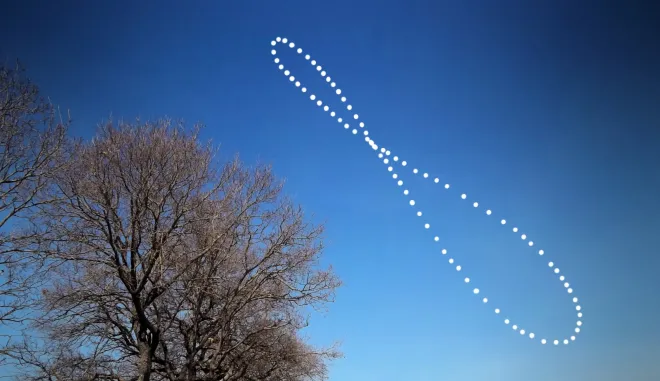 The analemma photographed over Italy across 2016. Photo: Giuseppe Donatiello, Wikimedia Commons (CC0).
.jpg)
What Does "Analemma" Mean?
The word comes from the Greek analemma, the pedestal or support of a sundial. Old sundials and many globes carry a small figure-eight diagram engraved on them: it was the correction table that turned "sundial time" into "clock time". Today the word names the figure itself: the path the Sun traces in the sky when observed at the same clock time through a year.
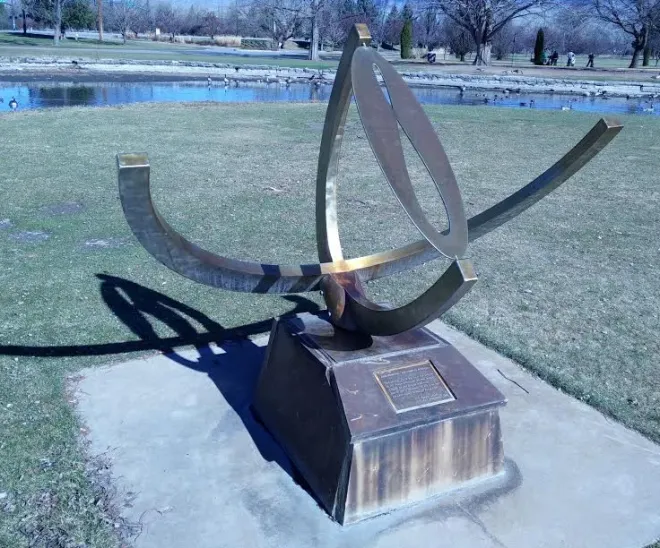 An analemmatic-equatorial sundial in Ann Morrison Park, Boise. Photo: Kencf0618, Wikimedia Commons (CC BY-SA 4.0).

Why Does the Sun Trace a Figure Eight?
Two independent quirks of Earth's motion combine to draw it:
The vertical swing comes from Earth's tilted axis. Our planet is tilted 23.4°, so through the year the Sun drifts from 23.4° north of the celestial equator to 23.4° south of it: a swing of almost 47° in declination. At mid-latitudes this is what makes the noon Sun ride that much higher in June than in December north of the equator (and the other way round south of it), drawing the long axis of the figure.
The east–west wobble comes from two effects working together. The tilt itself already makes the Sun run slightly fast or slow against the clock: a tilted Earth on a perfectly circular orbit would still trace a slim, symmetric figure-eight. Our slightly elliptical orbit adds a second push, since Earth moves faster near perihelion (early January) and slower near aphelion (July). Added together they form the equation of time, which puts the true Sun up to about 14 minutes behind or 16 minutes ahead of mean solar time. At a fixed clock hour, that shifts the Sun east or west of its average position: the width of the figure.
This wobble is also part of why a sundial disagrees with your watch, but only part: on top of the equation of time, your clock adds your position within the time zone and daylight saving, so the total gap can exceed an hour (it does in Madrid). Many old sundials carry a small figure-eight engraved next to the dial to correct for the equation-of-time share of it.
The two lobes are not equal: the small loop forms around one solstice and the large one around the other, because the equation of time is much stronger around the December solstice (Earth passes perihelion in early January) than around the June one. The solstices sit at the two extremes of the figure; the equinoxes lie close to the crossing point, though not exactly on it: another signature of our uneven orbital speed (the same quirk that explains why the shortest day is not the day with the earliest sunset).
One more subtlety before you explore your own figure: at a fixed clock hour, the days when the Sun stands highest and lowest are not exactly the solstices. The equation of time shifts them by a few days, which is why, in a northern city, the 12:00 Sun may bottom out around December 26 rather than December 21 (south of the equator a smaller shift of the same kind happens around the June solstice).
Why the Same Clock Time, and Not Solar Noon?
Because at solar noon the Sun is, by definition, exactly on the meridian: only its altitude changes with the seasons, so the "analemma at solar noon" collapses into a plain vertical line. It is only when you freeze the clock, not the Sun, that the east–west wander of the equation of time becomes visible and the line opens into an eight. (If you prefer the numeric version, the monthly tables on this site list both the solar noon time and the maximum Sun altitude for every day.)
The Same Sun, a Different Figure in Every City
The analemma is drawn on the sky, so where you stand changes how you see it:
Mid-northern latitudes (New York, Madrid, Tokyo) see the eight standing over the southern horizon, small loop on top. In the tropics and at the equator, the Sun passes nearly overhead, and the figure lies almost flat against the zenith. South of the equator the analemma appears with the small loop hanging at the bottom, the mirror of the northern sky. And inside the polar circles part of the figure sinks below the horizon: around midwinter the Sun simply never joins its own portrait.
Gold and blue dots mark the June and December solstices; green dots the equinoxes.
An Interactive Analemma Visualizer for Every City
You do not have to imagine any of this: every location page on this site now includes an interactive analemma visualizer. Open your city (say New York, Madrid or Sydney), scroll to the analemma, and hover over the curve to read the Sun's altitude and azimuth for every single day of the year.
Analemmas on Other Planets
Every planet has its own analemma, and its shape is a tug-of-war between axial tilt and orbital eccentricity. Change the balance between them and the eight deforms, opens, or vanishes:
Mercury has almost no tilt, so its analemma flattens into a simple east–west line. Thanks to its strange 3:2 spin-orbit resonance, a single solar day there lasts two Mercurian years. Venus, with an almost circular orbit and a tiny effective tilt (it rotates backwards, so the Sun rises in the west), produces a small ellipse. Mars is the famous one: its strong eccentricity swallows the small loop and the figure becomes a teardrop. Jupiter, barely tilted, draws a low, wide oval. Saturn keeps a lopsided figure-eight with a tiny upper loop, Uranus, which rolls around the Sun on its side, sweeps a gigantic eight across the sky, and Neptune traces a slim, elegant one much like Earth's. (Curious what sunsets look like out there? We have a whole article on that.)
How to Photograph an Analemma
It is one of astrophotography's slowest and most satisfying projects, first completed by Dennis di Cicco in 1978–79 after more than 40 exposures on a single frame of film. The recipe has not changed:
Solar safety first: photographing the Sun needs a solar filter made for your lens, fitted securely over its front. Never look at the Sun through an unfiltered optical viewfinder, and don't improvise: sunglasses, and even eclipse glasses, are not a substitute for a proper filter on the camera's optics.
Fix your camera position and framing for a full year. Shoot at exactly the same clock time, every 7–10 days, and always in standard time: if you follow your clock through a Daylight Saving change, the Sun will jump an hour sideways and cut your figure in two. Miss a few sessions to clouds and nothing is lost; the eight forgives gaps.
Does the Analemma Change From Year to Year?
On any human timescale, no: the figure repeats essentially identically every year (the leap-year cycle shifts each date's position by mere seconds of time). Over millennia it does evolve: the slow precession of Earth's perihelion redistributes the two lobes at roughly one day per sixty years, the axial tilt itself breathes between 22.1° and 24.5° on a 41,000-year cycle, and the orbit's eccentricity varies over 100,000 years. The analemma your great-grandchildren photograph will be, very subtly, a different eight.
No need to wait that long, though. Your city's analemma is already drawn: search for your location and hover over the curve to see the Sun's position for any day of the year.
Sources and Further Reading
United States Naval Observatory: The Equation of Time · A. Jenkins, "The Sun's position in the sky", European Journal of Physics 34 (2013) · Stanford Solar Center: Viewing and Understanding the Analemma · NASA: Solar Viewing Safety