Sunrise and sunset times in Alert
EditCheck out today's and tomorrow's sunrise and sunset times in Alert, as well as the whole calendar for October 2026.
Noticed slightly different times? We upgraded our calculations
Polar night until February 26, 2027: the Sun stays below the horizon all day (135 days, from October 15, 2026). The last sunset was on October 14, 2026 and the Sun rises again on February 27, 2027.Calculated for a flat horizon. Mountains can make polar night last days or weeks longer.
Today
October 20, 2026. Current time: 1:15:02 pm

Dawn at 8:18 am8:17:47 am
Dawn, first light: the start of civil twilight. The Sun is 6° below the horizon, and there is enough light to be outdoors without artificial light.
Sunrise time: Does not riseWhen the top edge of the Sun appears over a flat, clear horizon. Behind hills, mountains or buildings the Sun appears a few minutes later (or more in a valley).

Sunset time: Polar NightWhen the top edge of the Sun disappears below a flat, clear horizon. Behind hills, mountains or buildings the Sun disappears a few minutes earlier (or more in a valley).
Dusk at 3:26 pm3:26:23 pm
Dusk, when it gets dark: the end of civil twilight. The Sun reaches 6° below the horizon, and from then on artificial light is needed outdoors.·Night at 11:06 pm11:06:21 pm
End of astronomical twilight: the Sun is 18° below the horizon and the sky is dark enough to see the faintest stars. In a city it looks dark sooner.
Sun position chart
Now · Sun altitude: -3.48° (below the horizon) · Azimuth: 199.9° (S)
Daylight Golden Hour Dawn & dusk (civil twilight) Night
Day length: 0 minutes
The Sun stays below the horizon all day in Alert
 Moonrise: Oct 22, 5:08 pm
 Moonset: Oct 23, 3:02 amMoon phase: 🌔 Waxing Gibbous (69%)🌕 Full moon: Oct 26 at 12:11 am · 🌑 New moon: Nov 9 at 2:02 am
Tomorrow
October 21, 2026
Night ends at 12:45 am12:45:06 am
Start of astronomical twilight: the Sun is 18° below the horizon and the sky begins to brighten, too faintly to notice in a city.·Dawn at 8:32 am8:31:39 am
Dawn, first light: the start of civil twilight. The Sun is 6° below the horizon, and there is enough light to be outdoors without artificial light.
Sunrise time: Does not riseWhen the top edge of the Sun appears over a flat, clear horizon. Behind hills, mountains or buildings the Sun appears a few minutes later (or more in a valley).
Sunset time: Polar NightWhen the top edge of the Sun disappears below a flat, clear horizon. Behind hills, mountains or buildings the Sun disappears a few minutes earlier (or more in a valley).
Dusk at 3:12 pm3:12:18 pm
Dusk, when it gets dark: the end of civil twilight. The Sun reaches 6° below the horizon, and from then on artificial light is needed outdoors.·Night at 10:30 pm10:29:56 pm
End of astronomical twilight: the Sun is 18° below the horizon and the sky is dark enough to see the faintest stars. In a city it looks dark sooner.
Day length: 0 minutes
Tomorrow will be as long as today in Alert
Moonrise: Oct 22, 5:08 pm Moonset: Oct 23, 3:02 amMoon phase: 🌔 Waxing Gibbous (82%)
- Alert, Nunavut
- Latitude: 82.501778 (North)
- Longitude: -62.348091 (West)
- Time zone: Eastern Daylight Time (EDT, UTC−4)
Shortest day in Alert, Nunavut
The shortest day of the year will be in 2 months and 1 day, during the winter solstice on December 21, 2026. That day the Sun does not rise (polar night).Longest day in Alert, Nunavut
The longest day of the year was around 3 months ago, during the summer solstice on June 21, 2026. That day the Sun does not set (midnight sun).

October 2026 - Alert, Nunavut - Sunrise and sunset calendar
Sunrise and sunset times, civil twilight start and end times as well as solar noon, and day length for every day of October in Alert.
All times are in Alert's time: Eastern Daylight Time (EDT, UTC−4).
The day length shortens by 9 hours, 23 minutes over the course of October 2026 in Alert, Nunavut - from 9 hours, 23 minutes on the first day to 0 minutes on the last day.
| Day | First LightStart of civil twilight: the Sun is 6° below the horizon, and there is enough light to be outdoors without artificial light. | SunriseWhen the top edge of the Sun appears over a flat, clear horizon. Behind hills, mountains or buildings the Sun appears a few minutes later (or more in a valley). | Sunrise Variation |
SunsetWhen the top edge of the Sun disappears below a flat, clear horizon. Behind hills, mountains or buildings the Sun disappears a few minutes earlier (or more in a valley). | Sunset Variation |
Last LightEnd of civil twilight: the Sun reaches 6° below the horizon, and from then on artificial light is needed outdoors. | Day Length | Day Length Variation | Solar NoonTime of day when the sun reaches its highest point in the sky. | Max Sun Altitude | Nautical Twilight Start | Nautical Twilight End | Astronomical Twilight Start | Astronomical Twilight End | Night LengthCalculated from this day's sunset to the next day's sunrise. | Moon phase | Solar Midnight | Sun DeclinationThe latitude where the Sun is directly overhead at solar noon (the Sun's declination). It moves between the two tropics through the year. |
|---|---|---|---|---|---|---|---|---|---|---|---|---|---|---|---|---|---|---|
| Thu, Oct 1 | Twilight startStart of civil twilight: the Sun is 6° below the horizon, and there is enough light to be outdoors without artificial light.4:31:57 am | 7:15:01 am | +12m 9s | 4:38:06 pm | -12m 41s | Twilight endEnd of civil twilight: the Sun reaches 6° below the horizon, and from then on artificial light is needed outdoors.7:18:20 pm | 9h 23m 5s | -24m 50s | Solar noonTime of day when the sun reaches its highest point in the sky.11:59:01 am | 4.13° | — | — | — | — | Night lengthCalculated from this day's sunset to the next day's sunrise.14h 49m 19s | 🌖 (66%)Waning Gibbous: 66% illuminated at midnight, at the end of the day | 11:58:51 pm | 3.4° S |
| Fri, Oct 2 | 4:44:15 am | 7:27:25 am | +12m 24s | 4:25:11 pm | -12m 55s | 7:05:46 pm | 8h 57m 46s | -25m 18s | 11:58:41 am | 3.74° | — | — | — | — | 15h 14m 55s | 🌖 (55%)Waning Gibbous: 55% illuminated at midnight, at the end of the day | 11:58:32 pm | 3.8° S |
| Sat, Oct 3 | 4:56:17 am | 7:40:06 am | +12m 41s | 4:12:00 pm | -13m 11s | 6:53:26 pm | 8h 31m 54s | -25m 53s | 11:58:22 am | 3.36° | — | — | — | — | 15h 41m 8s | 🌗 (43%) Last quarter at 9:25 amLast quarter at 9:25 am. At midnight, at the end of the day: 43% illuminated |
11:58:13 pm | 4.1° S |
| Sun, Oct 4 | 5:08:08 am | 7:53:08 am | +13m 2s | 3:58:27 pm | -13m 33s | 6:41:16 pm | 8h 5m 19s | -26m 35s | 11:58:04 am | 2.97° | — | 11:04:52 pm | — | — | 16h 8m 9s | 🌘 (32%)Waning Crescent: 32% illuminated at midnight, at the end of the day | 11:57:55 pm | 4.5° S |
| Mon, Oct 5 | 5:19:49 am | 8:06:36 am | +13m 28s | 3:44:29 pm | -13m 58s | 6:29:14 pm | 7h 37m 53s | -27m 26s | 11:57:46 am | 2.59° | 12:54:40 am | 10:27:50 pm | — | — | 16h 36m 6s | 🌘 (22%)Waning Crescent: 22% illuminated at midnight, at the end of the day | 11:57:37 pm | 4.9° S |
| Tue, Oct 6 | 5:31:23 am | 8:20:35 am | +13m 59s | 3:30:00 pm | -14m 29s | 6:17:20 pm | 7h 9m 25s | -28m 29s | 11:57:28 am | 2.20° | 1:31:10 am | 10:01:27 pm | — | — | 17h 5m 15s | 🌘 (14%)Waning Crescent: 14% illuminated at midnight, at the end of the day | 11:57:19 pm | 5.3° S |
| Wed, Oct 7 | 5:42:51 am | 8:35:15 am | +14m 40s | 3:14:51 pm | -15m 9s | 6:05:30 pm | 6h 39m 36s | -29m 48s | 11:57:10 am | 1.82° | 1:57:00 am | 9:39:37 pm | — | — | 17h 35m 54s | 🌘 (7%)Waning Crescent: 7% illuminated at midnight, at the end of the day | 11:57:02 pm | 5.7° S |
| Thu, Oct 8 | 5:54:15 am | 8:50:45 am | +15m 30s | 2:58:52 pm | -15m 59s | 5:53:44 pm | 6h 8m 7s | -31m 28s | 11:56:53 am | 1.44° | 2:18:19 am | 9:20:27 pm | — | — | 18h 8m 28s | 🌘 (3%)Waning Crescent: 3% illuminated at midnight, at the end of the day | 11:56:45 pm | 6.1° S |
| Fri, Oct 9 | 6:05:37 am | 9:07:20 am | +16m 35s | 2:41:49 pm | -17m 3s | 5:42:00 pm | 5h 34m 29s | -33m 38s | 11:56:36 am | 1.06° | 2:36:59 am | 9:03:04 pm | — | — | 18h 43m 35s | 🌘 (0.4%)Waning Crescent: 0.4% illuminated at midnight, at the end of the day | 11:56:28 pm | 6.4° S |
| Sat, Oct 10 | 6:17:00 am | 9:25:24 am | +18m 4s | 2:23:18 pm | -18m 31s | 5:30:16 pm | 4h 57m 54s | -36m 35s | 11:56:20 am | 0.68° | 2:53:52 am | 8:47:00 pm | — | — | 19h 22m 16s | 🌑 (0.4%) New moon at 11:50 amNew moon at 11:50 am. At midnight, at the end of the day: 0.4% illuminated |
11:56:12 pm | 6.8° S |
| Sun, Oct 11 | 6:28:23 am | 9:45:34 am | +20m 10s | 2:02:41 pm | -20m 37s | 5:18:31 pm | 4h 17m 7s | -40m 48s | 11:56:04 am | 0.30° | 3:09:28 am | 8:31:57 pm | — | — | 20h 6m 26s | 🌒 (3%)Waxing Crescent: 3% illuminated at midnight, at the end of the day | 11:55:57 pm | 7.2° S |
| Mon, Oct 12 | 6:39:50 am | 10:09:07 am | +23m 33s | 1:38:43 pm | -23m 58s | 5:06:43 pm | 3h 29m 36s | -47m 31s | 11:55:49 am | -0.07° | 3:24:05 am | 8:17:40 pm | — | — | 21h 0m 29s | 🌒 (7%)Waxing Crescent: 7% illuminated at midnight, at the end of the day | 11:55:42 pm | 7.6° S |
| Tue, Oct 13 | 6:51:22 am | 10:39:12 am | +30m 5s | 1:08:13 pm | -30m 30s | 4:54:51 pm | 2h 29m 1s | -1h 0m 35s | 11:55:34 am | -0.45° | 3:37:55 am | 8:04:03 pm | — | — | 22h 30m 8s | 🌒 (12%)Waxing Crescent: 12% illuminated at midnight, at the end of the day | 11:55:27 pm | 7.9° S |
| Wed, Oct 14 | 7:03:01 am | 11:38:21 am | +59m 9s | 12:08:40 pm | -59m 33s | 4:42:52 pm | 30m 19s | -1h 58m 42s | 11:55:20 am | -0.82° | 3:51:07 am | 7:50:58 pm | — | — | — | 🌒 (19%)Waxing Crescent: 19% illuminated at midnight, at the end of the day | 11:55:14 pm | 8.3° S |
| Thu, Oct 15 | 7:14:50 am | Does not rise | — | Polar Night | — | 4:30:44 pm | 0m 0s | -30m 19s | 11:55:07 am | -1.19° | 4:03:49 am | 7:38:19 pm | — | — | 24h 0m 0s | 🌒 (27%)Waxing Crescent: 27% illuminated at midnight, at the end of the day | 11:55:01 pm | 8.7° S |
| Fri, Oct 16 | 7:26:49 am | Does not rise | — | Polar Night | — | 4:18:26 pm | 0m 0s | 0s | 11:54:54 am | -1.56° | 4:16:05 am | 7:26:04 pm | — | — | 24h 0m 0s | 🌒 (36%)Waxing Crescent: 36% illuminated at midnight, at the end of the day | 11:54:48 pm | 9.1° S |
| Sat, Oct 17 | 7:39:04 am | Does not rise | — | Polar Night | — | 4:05:54 pm | 0m 0s | 0s | 11:54:41 am | -1.92° | 4:27:59 am | 7:14:09 pm | — | — | 24h 0m 0s | 🌒 (45%)Waxing Crescent: 45% illuminated at midnight, at the end of the day | 11:54:35 pm | 9.4° S |
| Sun, Oct 18 | 7:51:35 am | Does not rise | — | Polar Night | — | 3:53:06 pm | 0m 0s | 0s | 11:54:29 am | -2.28° | 4:39:35 am | 7:02:30 pm | — | — | 24h 0m 0s | 🌓 (55%) First quarter at 12:12 pmFirst quarter at 12:12 pm. At midnight, at the end of the day: 55% illuminated |
11:54:24 pm | 9.8° S |
| Mon, Oct 19 | 8:04:28 am | Does not rise | — | Polar Night | — | 3:39:57 pm | 0m 0s | 0s | 11:54:18 am | -2.65° | 4:50:55 am | 6:51:06 pm | — | — | 24h 0m 0s | 🌔 (64%)Waxing Gibbous: 64% illuminated at midnight, at the end of the day | 11:54:13 pm | 10.1° S |
| Tue, Oct 20 | 8:17:47 am | Does not rise | — | Polar Night | — | 3:26:23 pm | 0m 0s | 0s | 11:54:07 am | -3.00° | 5:02:02 am | 6:39:55 pm | — | 11:06:21 pm | 24h 0m 0s | 🌔 (73%)Waxing Gibbous: 73% illuminated at midnight, at the end of the day | 11:54:02 pm | 10.5° S |
| Wed, Oct 21 | 8:31:39 am | Does not rise | — | Polar Night | — | 3:12:18 pm | 0m 0s | 0s | 11:53:57 am | -3.36° | 5:12:58 am | 6:28:55 pm | 12:45:06 am | 10:29:56 pm | 24h 0m 0s | 🌔 (82%)Waxing Gibbous: 82% illuminated at midnight, at the end of the day | 11:53:53 pm | 10.9° S |
| Thu, Oct 22 | 8:46:10 am | Does not rise | — | Polar Night | — | 2:57:33 pm | 0m 0s | 0s | 11:53:48 am | -3.71° | 5:23:45 am | 6:18:05 pm | 1:21:14 am | 10:04:40 pm | 24h 0m 0s | 🌔 (89%)Waxing Gibbous: 89% illuminated at midnight, at the end of the day | 11:53:44 pm | 11.2° S |
| Fri, Oct 23 | 9:01:34 am | Does not rise | — | Polar Night | — | 2:41:58 pm | 0m 0s | 0s | 11:53:39 am | -4.06° | 5:34:23 am | 6:07:22 pm | 1:46:14 am | 9:43:59 pm | 24h 0m 0s | 🌔 (95%)Waxing Gibbous: 95% illuminated at midnight, at the end of the day | 11:53:35 pm | 11.6° S |
| Sat, Oct 24 | 9:18:06 am | Does not rise | — | Polar Night | — | 2:25:16 pm | 0m 0s | 0s | 11:53:31 am | -4.41° | 5:44:55 am | 5:56:47 pm | 2:06:40 am | 9:25:58 pm | 24h 0m 0s | 🌔 (99%)Waxing Gibbous: 99% illuminated at midnight, at the end of the day | 11:53:28 pm | 11.9° S |
| Sun, Oct 25 | 9:36:12 am | Does not rise | — | Polar Night | — | 2:07:01 pm | 0m 0s | 0s | 11:53:24 am | -4.76° | 5:55:22 am | 5:46:17 pm | 2:24:27 am | 9:09:47 pm | 24h 0m 0s | 🌔 (99.8%)Waxing Gibbous: 99.8% illuminated at midnight, at the end of the day | 11:53:21 pm | 12.3° S |
| Mon, Oct 26 | 9:56:36 am | Does not rise | — | Polar Night | — | 1:46:28 pm | 0m 0s | 0s | 11:53:18 am | -5.10° | 6:05:45 am | 5:35:52 pm | 2:40:27 am | 8:54:55 pm | 24h 0m 0s | 🌕 (98%) Full moon at 12:11 amFull moon at 12:11 am. At midnight, at the end of the day: 98% illuminated |
11:53:15 pm | 12.6° S |
| Tue, Oct 27 | 10:20:55 am | Does not rise | — | Polar Night | — | 1:22:03 pm | 0m 0s | 0s | 11:53:12 am | -5.44° | 6:16:05 am | 5:25:31 pm | 2:55:08 am | 8:41:05 pm | 24h 0m 0s | 🌖 (94%)Waning Gibbous: 94% illuminated at midnight, at the end of the day | 11:53:10 pm | 12.9° S |
| Wed, Oct 28 | 10:53:53 am | Does not rise | — | Polar Night | — | 12:49:00 pm | 0m 0s | 0s | 11:53:07 am | -5.77° | 6:26:23 am | 5:15:12 pm | 3:08:49 am | 8:28:05 pm | 24h 0m 0s | 🌖 (88%)Waning Gibbous: 88% illuminated at midnight, at the end of the day | 11:53:05 pm | 13.3° S |
| Thu, Oct 29 | — | Does not rise | — | Polar Night | — | — | 0m 0s | 0s | 11:53:03 am | -6.10° | 6:36:41 am | 5:04:55 pm | 3:21:42 am | 8:15:46 pm | 24h 0m 0s | 🌖 (79%)Waning Gibbous: 79% illuminated at midnight, at the end of the day | 11:53:02 pm | 13.6° S |
| Fri, Oct 30 | — | Does not rise | — | Polar Night | — | — | 0m 0s | 0s | 11:53:00 am | -6.43° | 6:46:59 am | 4:54:39 pm | 3:33:55 am | 8:04:01 pm | 24h 0m 0s | 🌖 (69%)Waning Gibbous: 69% illuminated at midnight, at the end of the day | 11:52:59 pm | 13.9° S |
| Sat, Oct 31 | — | Does not rise | — | Polar Night | — | — | 0m 0s | 0s | 11:52:57 am | -6.75° | 6:57:19 am | 4:44:22 pm | 3:45:35 am | 7:52:47 pm | 24h 0m 0s | 🌖 (58%)Waning Gibbous: 58% illuminated at midnight, at the end of the day | 11:52:56 pm | 14.3° S |
💡 Got a cool idea? 🤦 Found any errors?
We're always improving this website!
Year distribution of sunrise and sunset times in Alert, Nunavut - 2026
The following graph shows sunrise and sunset times in Alert, Nunavut for every day of the year. There are two jumps in the graph that represent the hour change for Daylight Saving Time (DST) in Alert, Nunavut.
Daylight Dawn & dusk (civil twilight) Night Solar noon · Vertical steps in the curves = DST clock change
Earliest and latest sunrise and sunset in Alert
In Alert, the earliest sunrise of 2026 is on September 6 at 1:05 am, while the latest sunrise is on October 14 at 11:38 am. The earliest sunset is on October 14 at 12:08 pm, and the latest sunset is on September 5 at 11:14 pm.
Alert gets 24h 00m more daylight on the longest day than on the shortest one (24h 00m versus 0h 00m). Averaged over the whole year, a day lasts 12h 32m.
Alert Analemma
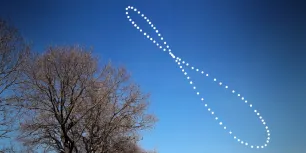
Due to Earth's tilted axis and slightly elliptical orbit, the Sun is never seen in the same position at noon in Alert. Throughout the year, it slowly traces this figure-eight:
Move along the curve to read the Sun's altitude and azimuth for any day of the year in Alert.
Over the year, the 12:00 Sun ranges from 16.1° below the horizon (around Dec 21) to 30.8° above it (around Jun 21) in Alert. The smaller loop sits at the top, the signature of a Northern Hemisphere analemma. For about 144 days around midwinter the whole figure sinks below the horizon — the Sun does not rise at noon at all. Notice the whole figure leans west of the meridian: over Alert the Sun reaches its highest point between 10:52 and 11:23 depending on the time of year, but always before 12:00.
Detailed Analemma Chart
The technical chart below plots one dot per day, labels the first day of each month, marks the solstices, equinoxes, perihelion and aphelion, and draws the noon altitude of the equinoxes (90° minus your latitude) together with its ±23.4° seasonal limits.
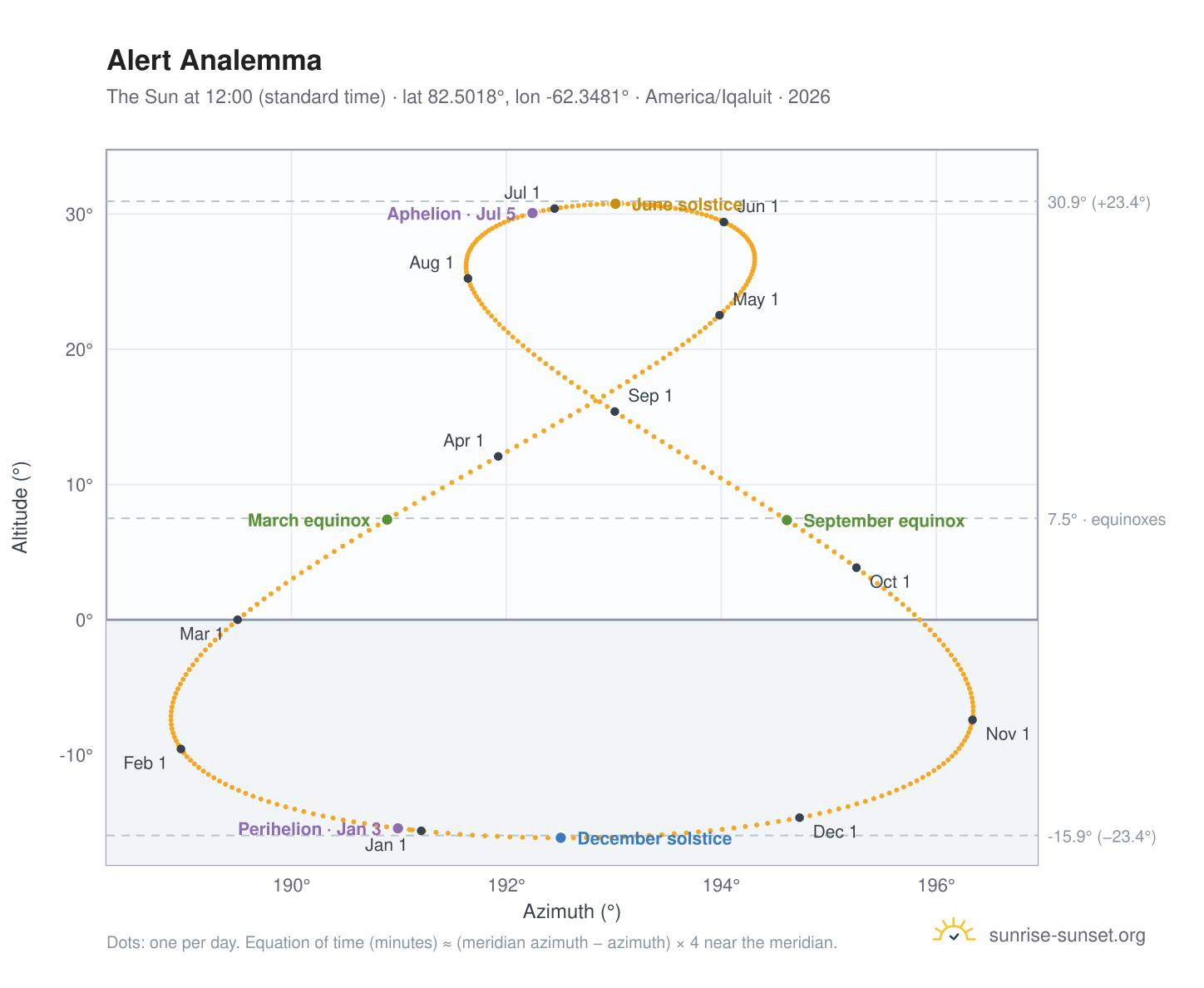

Why does the figure look wider here than in the sky view above?
Both draw the same data, but with different conventions. The sky view uses the same scale on both axes, so it shows the analemma with its true proportions, as a camera would capture it: about 47° tall and only a few degrees wide. This chart, like most technical analemma diagrams, stretches each axis independently to fill the plot, expanding the narrow azimuth range several times so its day-to-day variation can actually be read. Also, azimuth is not sky distance: near the zenith, one degree of azimuth spans much less than one degree across the sky, which further widens the figure in this representation.